
· Dana Whitfield
How to Weave a Rug on a Frame Loom: Yarn Weight, Warp Spacing and Finishing
A rug is the project people ask about once the first wall hanging is off the frame, and it is the one the tutorials skip. It asks for the opposite of what a wall hanging taught you: fewer warp threads, not more; a weft you can barely fit on the shuttle; and a beat that goes on until the warp disappears.
This guide is that project, on the frame you already own. The tool itself is our frame loom guide; the order of operations is our step by step guide, and neither is repeated here. What follows is what changes when the piece goes on the floor instead of the wall.
What size rug a frame loom actually weaves
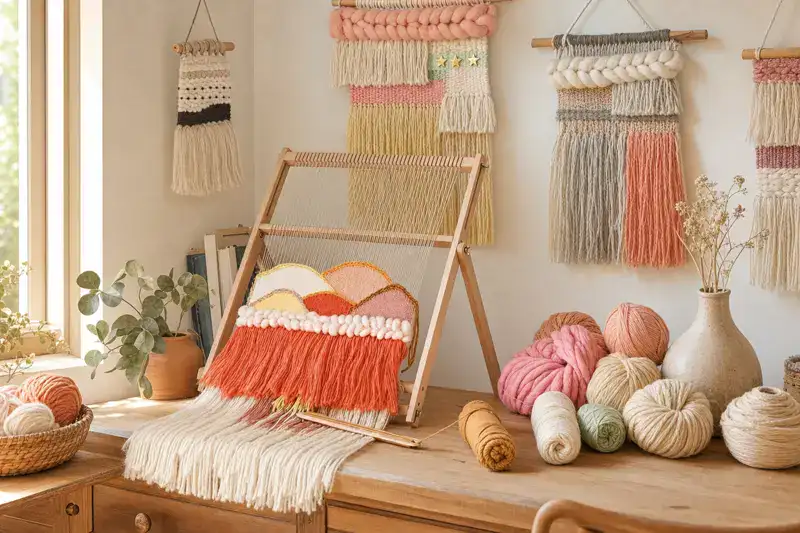
A rug earns its place by width, because a narrow strip on the floor reads as a runner cut short, so this is the one project where our beginners guide, which argues for starting narrower, gives way on size. Count backwards from the finished figure: our finishing guide keeps roughly a hand span of bare warp at each end, and on a rug that allowance is not optional, because those knots are what stop it unravelling under a foot. Kit contents by size are on our weaving loom kit page.
Choosing a warp that will take a foot
On a wall hanging the warp is scaffolding: nothing pulls on it. A rug is walked on, dragged, shaken and folded, and every one of those forces travels through the warp. Choose it as you would choose a rope, not a color; it will be covered completely.
Two properties decide it. Smoothness lets the weft slide down under the comb, and a rug is beaten harder than anything else you will weave on this frame. Low stretch keeps it flat once the tension comes off: an elastic warp relaxes when you cut it free, and the rows that were packed tight loosen with it. If a thread stretches noticeably between your hands, it belongs on a hanging.
Warp spacing: every other notch, not every one
The notches on the bars are cut for tapestry and plain weave, where the weft is fine and the warp sits close. That is why the Large kit adds a notched rod: it brings the warp closer still on detailed work, as our tapestry weaving basics guide explains. A rug goes the other way. Thick yarn takes a wide, lazy curve around each thread it passes, and with warp at every notch that curve has nowhere to go: the row sits on top of the warp, the comb cannot drive it down, and the fabric comes out stiff and gappy.
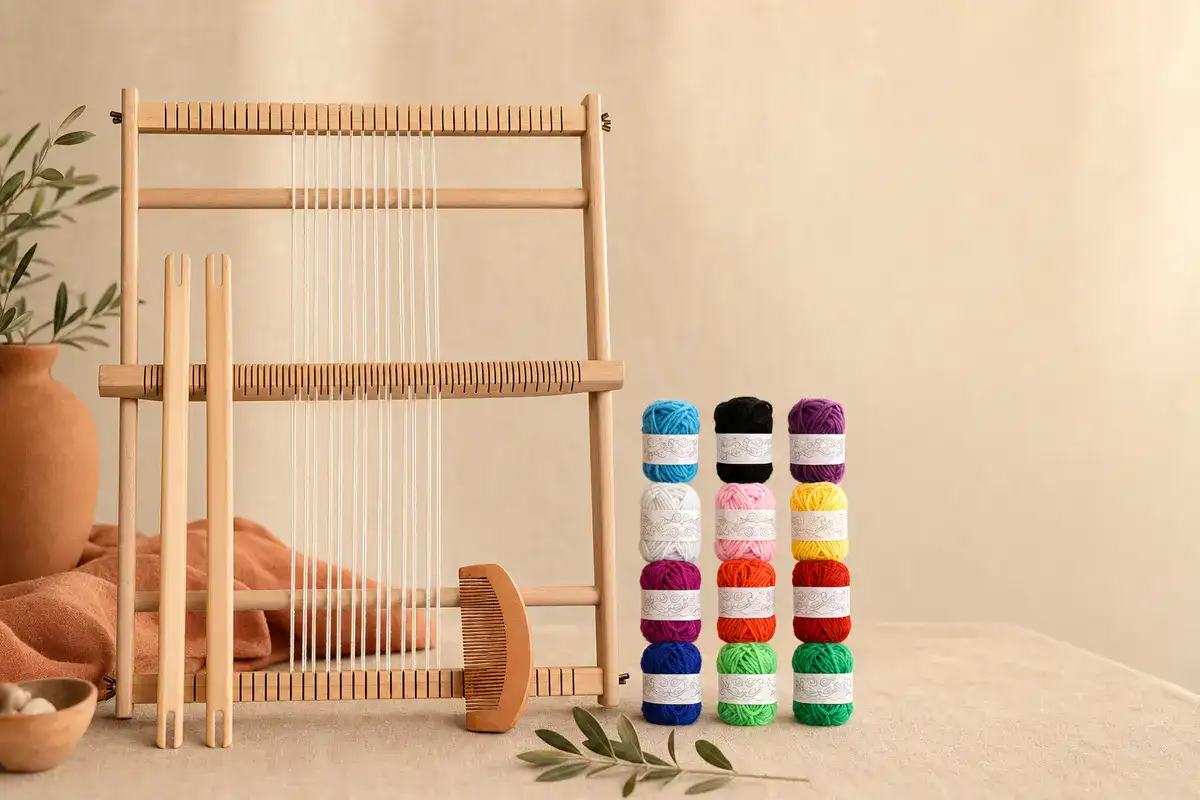
Skipping every other notch fixes it in one move, and the thread still lands at a consistent interval, because the notches are doing the measuring for you. Wind from the first notch to the third, back up to the fifth, and so on, keeping the same rhythm across the width so the spacing never drifts.
Test before you commit. Weave a few rows of your rug weft across the first warp you wind, beat them hard, and look from the side. A weft flattened into a solid band with no warp visible means the spacing is right. Rows that stay rounded mean the warp is still too close for that yarn, and rewinding now is quicker than at row thirty.
Yarn weight for the weft: bulk, and where to find it
Weight does two jobs. It fills: each pass lays down a thick row, so the piece builds fast and has enough body to lie flat rather than curl. And it cushions: the weft is the surface underfoot, and bulk is what makes a woven mat feel like a rug rather than a placemat.
You do not need a special rug yarn to start. Carry two or three strands together and weave them as a single weft, and the bundle behaves like the bulky category above. This is where the 12-color set in every LoomCraft box does its rug work: sky blue with royal blue, pine green with light green, orange with red, and the twelve skeins become a palette of marled pairs. Keep the number of strands the same from first row to last, because two strands beside three packs to a different height and shows as a ridge. Wind them onto the forked shuttle together, from the same end, so they stay parallel.
Tension: firm, even, and checked as the rug grows
A thick weft pushes the warp apart as it goes in, and every hard beat drives that further. On a wall hanging you set the tension once and forget it; on a rug the same force that packs the weft is working on the frame, so check that all four corner wing nuts are snug before the first row, and again after your first hour. Equal is the part that shows: a thread looser than its neighbors lets the weft sink deeper there, and the soft channel that leaves runs the length of the piece.
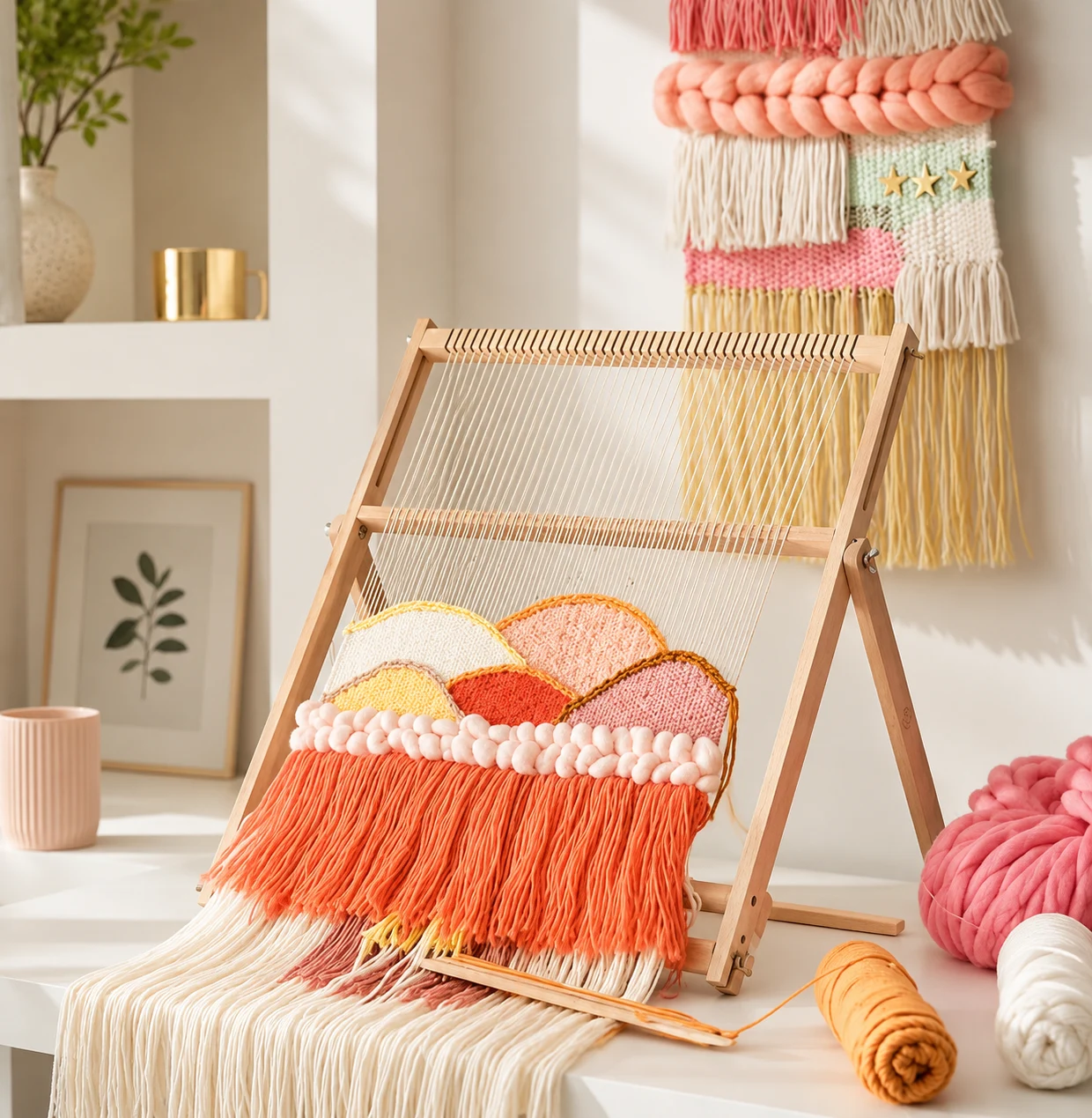
The A-frame's removable pegs, described on our product page, let you shift the crossbar and reinsert it to take up slack when the middle rows start feeling softer than the first.
Weft density: beat after every row, and keep the arc
Our tapestry weaving basics guide covers why weft-faced fabric is beaten after every row rather than every three; a rug is that technique with a heavier hand. Use the comb's full width on each pass, straight down, and if a thread of warp still catches the light, beat it again. Under-beating shows as warp lines on a hanging; on a rug it also shows as a thin spot that wears first.
The arc matters more, not less. Our drawing in guide explains why every row needs more weft than the straight distance across, and a bulky weft wrapping widely spaced threads needs more spare length than a fine one. Leave each row sitting as a taller hill than feels right, place the shuttle at the edge rather than pulling it snug, then beat. Check the width against the first rows every ten rows.
Stripes are the natural rug pattern: the thick weft rounds every corner it turns, so crisp shapes stay with tapestry.
| What changes | Wall hanging | Rug |
|---|---|---|
| Warp | Any smooth thread, shown or covered | Strong, smooth, low-stretch, fully covered |
| Notches used | Every notch, or closer with the notched rod | Every other notch |
| Weft | Fine to medium, one strand | Bulky, or two to three strands held as one |
| Beating | Every two to three rows, every row for tapestry | Every row, harder, until no warp shows |
| Finish | Fringe, tassels or a folded hem | Hemstitch both ends, square knots, short fringe |
What our beating test implies for a rug: Dana wove matched swatches at three beating frequencies, and the every-third-row swatch still showed warp lines once finished; full results are in our tapestry weaving basics guide. A rug is where that finding bites hardest: the warp is spaced wider than on any tapestry, so a row left loose shows more of it, and those are the rows a foot lands on.
Finishing a rug so it survives the floor
The mechanics live in our finishing guide: packing the last rows, hemstitching under tension, square knots slid snug against the fabric, and the choice between sliding the loops off and cutting. None of it changes for a rug; what changes is how much each step carries. A wall hanging's knots hold its own weight, a rug's hold against a heel dragging across them, so knot every pair from the center outwards.
Fringe on a rug is decoration that gets stepped on. Loose fringe trimmed short holds up on a bedside mat; twisted tassels resist fraying where the rug is walked over daily, and their counter-twist keeps them from matting. The folded hem the finishing guide keeps for thin fabric is out: a rug is too thick to fold flat.
Weft tails need more care than on a hanging. Run each one back along its own row for four or five warp threads rather than three, because the rug flexes every time it is lifted and a short tail works its way out. Do it while the piece is still under tension.
Verified buyers who rate this loom five stars; the most common complaint in the same corpus is missing instructions, which is what a project guide is for
— LoomCraft verified review breakdown, 2026
Americans who knit or crochet, the pool already used to handling bulky yarn
— Craft Yarn Council, 2024
of U.S. adults now identify as crafters, part of the demand keeping simple hand looms in circulation
Frequently asked
Can I weave a rug on a frame loom, or does it take a rug loom?
Yes, at the size the frame allows. A rug is a weft-faced weave with a thick weft on a strong warp, and a frame loom weaves exactly that. The Large LoomCraft frame is 60 × 47 cm, so the rug is a bedside or bathroom mat.
Which LoomCraft size should I weave a rug on?
Large. A rug uses its width, the third shuttle keeps three stripe colors wound and ready, and the frame carries the firm tension a bulky weft needs. Medium weaves a smaller mat by the same method; Small suits a coaster or a mug rug.
Do I have to skip notches, or can I warp every one?
Skip. A bulky weft has to bend over and under each warp thread, and threads set in every notch leave it no room, so the rows refuse to pack and the warp shows through. Every notch is for a fine tapestry, not a rug.
Can I use the 12 colors from the kit as rug weft?
Yes, held together. Any yarn gains bulk when you carry two or three strands as one weft, and the twelve colors held in pairs give marled stripes. Keep the number of strands the same from first row to last so the density stays even.

Dana Whitfield · Textile Craft Curator, LoomCraft
Dana test-weaves every LoomCraft size on real tapestry projects, timing setup, checking warp tension, and how the notched bars hold up.
Reviewed and updated September 4, 2026. See how we test, or the terminology in our frame loom guide.
Related reading: How to use a weaving loom · How to finish a weaving · Why your weaving pulls in · Reviews · All guides
The rug-sized frame: 60 × 47 cm, three shuttles, notched rod and 12 yarn colors included. Arrives in 6 to 10 business days.