
· Dana Whitfield
Why Your Weaving Pulls In at the Edges
It usually announces itself around row twenty. You started the full width of your warp, you have been weaving steadily, and then you glance down and the fabric has a waist. The frame has not moved.
Weavers call this drawing in, and it catches almost everyone on a first project. It is not a fault in your frame and not a sign you warped badly: it is geometry, and one of the few weaving problems you can stop completely once you see why it starts. The tool itself is our frame loom guide; the order of operations is our step by step guide. This is diagnosis.
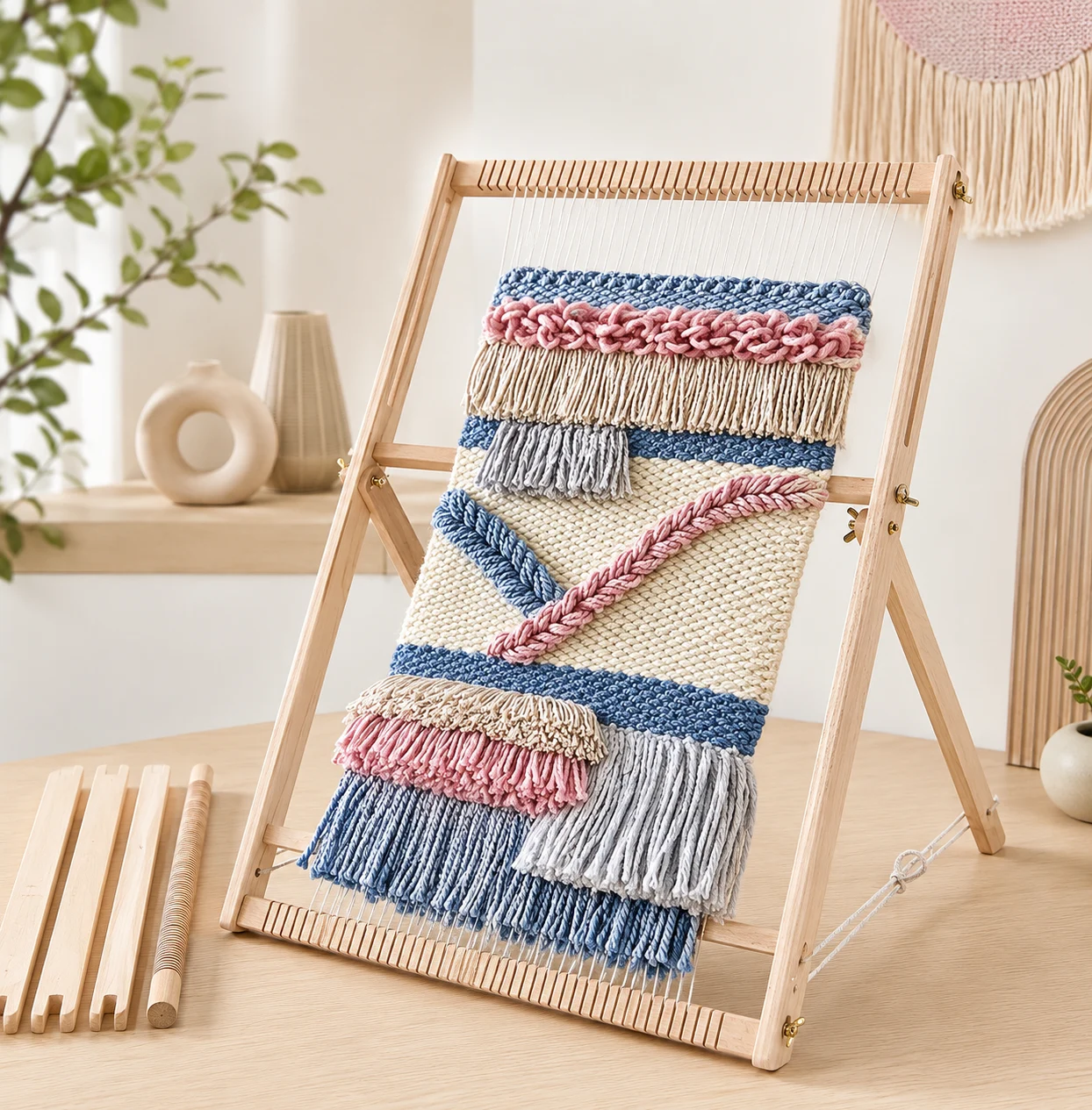
What drawing in actually is
Picture a row before it is beaten. The yarn lies loosely on top of the warp, still nearly straight, because nothing has forced it to bend yet. Then the comb pushes it down. Only at that moment does the weft wrap around each thread it passes, and wrapping costs length.
If the row was given exactly the straight distance across, there is no spare yarn to pay for that wrapping. It packs down anyway, because the comb is stronger than the yarn, and finds the length in the only place it can reach: the two ends. Your outer threads move inward a fraction. On one row that is invisible. Do it forty times and the piece tapers toward your hands.
Why it happens even when your warp tension is perfect
This is the misdiagnosis I see most often. Someone spots the taper, assumes the warp is sagging, and rewinds it tighter. It happens again, so they go tighter still. You can warp to the taut guitar string we describe in the step by step guide and still draw in on every row: a tight warp hands the weft no extra yarn.
The second point changes how you think about the problem: no mechanism removes drawing in. A loom with a moving heddle opens the gap between the warp threads for you, the real difference between the two tools and one our frame loom guide sets out in full. It still does not lay the weft in for you, so that weaver draws in too if the row was short.
The fix: lay the weft in an arc
It is one small change to a motion you already make. Pass the shuttle across as usual, then, before the comb goes near it, lift the middle of the row with a finger so it bows upward. Now beat. The comb flattens the hill, the yarn spends that length wrapping each thread, and your outer threads stay put.
How tall the arc needs to be depends on how far the row travels. On a Small 39 × 27 cm frame a gentle curve covers it; across the Large 60 × 47 cm frame the row crosses far more threads, so the hill has to be taller. This is why moving up a size can bring drawing in back on a technique you thought you had solved.
One habit undoes all of it. When the shuttle comes out the far side, resist the urge to pull the tail to tidy the edge: that tug drags the arc straight again and hands the row back to the short-length problem. Place the weft, do not pull it. If the edge looks untidy before beating, it is supposed to.
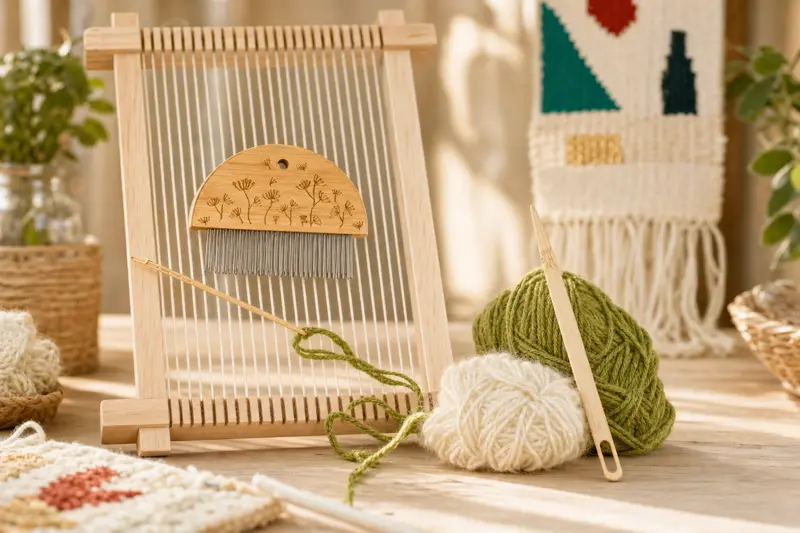
How beating with the comb changes your edges
That timing is the whole reason the arc comes first. Weavers who beat out of habit and then check the edge are inspecting a decision already made. Arc, look, then beat.
Pressure matters too, specifically at the sides. Pulling the comb toward you at an angle near the edges, natural when your wrist is at the end of its travel, packs the outer inch harder than the middle and drags those threads in on its own. Beat straight down through the full width instead. Tapestry concentrates all of it: weft-faced weaving means beating after every row, as our tapestry weaving basics guide covers, so a short row is locked down fast.
Reading the shape: a steady taper, wavy edges, or something else
| What the edge looks like | What it usually is | What to change |
|---|---|---|
| Both sides taper evenly, and it keeps going | Not enough weft length in any row | Arc every row before the comb touches it |
| One side pulls in, the other stays put | Tugging the tail on the side you finish on | Place the shuttle, never pull it snug |
| Edges wavy or scalloped, width roughly holds | Arc height changing row to row | The same arc every row, not just when you remember |
| Small loops poking out at the selvedge | More arc than the row can absorb | Flatten the curve slightly |
| Width holds but the fabric shows gaps | Under-beating, a different problem | Beat every two to three rows instead |
That last row matters: gapping and drawing in want opposite corrections, and pulling the weft tighter to close a gap is exactly the move that starts a taper.
Rescuing a piece that has already narrowed
Unpicking is less alarming than it sounds, because you are only removing weft. Your warp is one continuous thread wound between the notches, as our finishing guide explains, so pulling rows back out leaves it untouched. Work downward until the width is right again, then start over with the arc.
If the taper is mild, correct from the next row on instead. Everything above sits parallel and the piece reads as having a slight shoulder rather than a cone, which on a wall hanging with fringe almost nobody notices. The third option is not a consolation prize: a smooth, symmetrical taper is a shape, and once the piece is deliberate around it, it stops looking like an error. An inconsistent edge is the one worth unpicking.
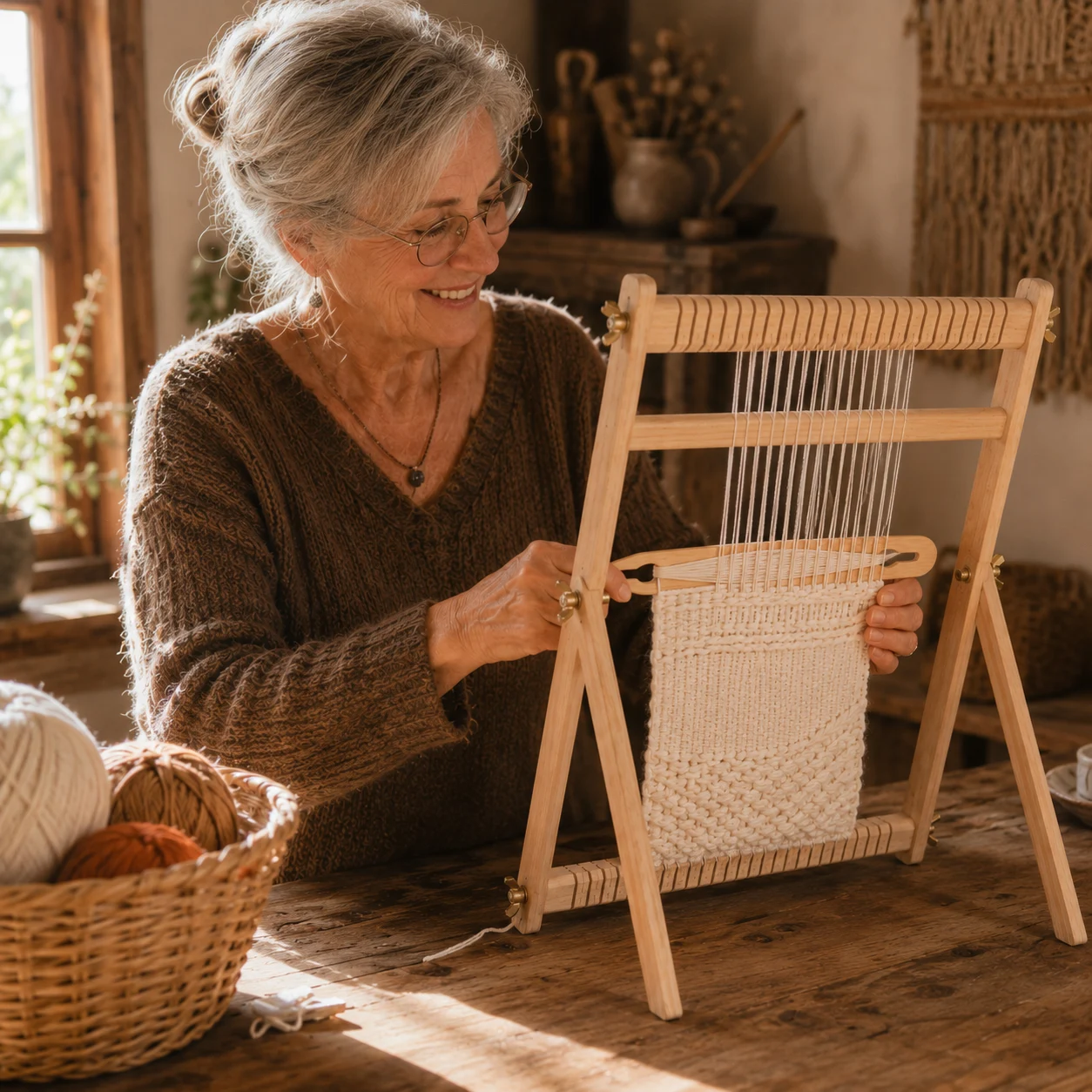
What changes on a wider frame
This is the practical argument behind the sizing advice in our beginners guide, which recommends starting narrower than you think you want. A wide frame is no harder to operate; it simply gives a small repeated habit more room to compound before you notice it.
Even warp spacing helps too, because edge threads at predictable intervals move predictably, and a shifted selvedge is easier to spot. The notched rod in the Large kit is there for exactly that on wider pieces. Every LoomCraft size ships with the frame, comb, forked shuttles and the 12-color yarn set; the weaving loom kit page lists what is in each box.
One habit for wide work: check your width every ten rows rather than at the end, while the correction is still a small one.
of U.S. adults now consider themselves crafters, which is a great many people meeting drawing in for the first time
Americans who knit or crochet, a reminder that yarn handling is a mainstream skill rather than a niche one
— Craft Yarn Council, 2024
Hand-crafters surveyed across 39 countries who linked more frequent practice with feeling calmer and happier
— Riley, Corkhill & Morris, British Journal of Occupational Therapy, 2013
Frequently asked
Is drawing in a sign something is wrong with my loom?
No. Drawing in comes from how weft yarn travels through cloth, not from the frame holding it. Nothing in the frame decides how much weft length goes into a row, and that is what sets your width. Looms with a moving heddle draw in the same way.
How much narrowing counts as normal?
Every hand-woven piece narrows a little, and a difference you have to hunt for is nothing to chase. The one worth correcting is the one you can see from across the room, or the one that keeps growing instead of settling. Weave a small sampler first and you will learn what your own hands do.
Can I fix it by tightening the warp?
No, and it is the first thing almost everyone tries. Warp tension decides whether your rows sit parallel and whether the comb packs them evenly. It does not decide width. A tighter warp gives the row no extra weft to bend around each thread with, so it still borrows from your outer threads.
Does this happen in tapestry weaving too?
Yes, and it shows sooner. Weft-faced tapestry is beaten harder and after every row, so a row laid in without enough slack locks down almost immediately. The arc matters more in tapestry, not less.

Dana Whitfield · Weaving Editor, LoomCraft
Dana writes LoomCraft's weaving guides: warping, weaving and finishing on a frame loom, from a first coaster to a wall hanging.
Reviewed and updated August 10, 2026. See the terminology in our frame loom guide.
Related reading: How to use a weaving loom · How to finish a weaving · Tapestry weaving basics · All guides
Frame, comb, two shuttles and 12 yarn colors included. Arrives in 6 to 10 business days.