
What Is a Frame Loom, and How It Works
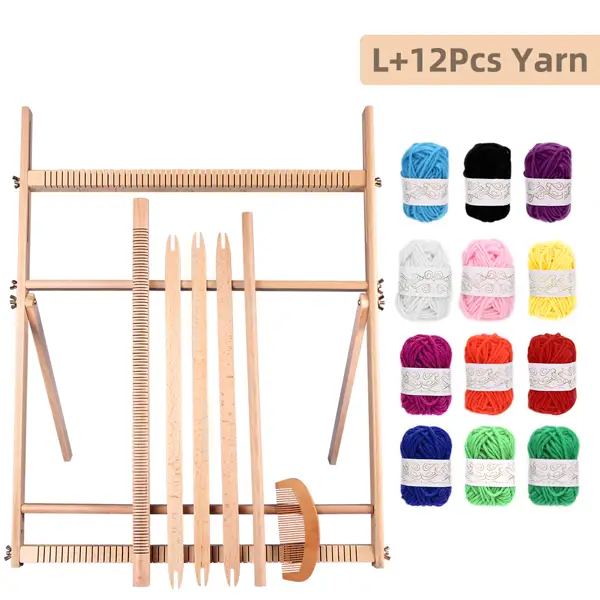
Search "frame loom" and you'll find it used loosely to mean almost any small hand loom. So here's the specific, version: a frame loom (also called a tapestry loom or hand loom) is a fixed frame — ours is A-shaped, joined with wood dowels and gold butterfly screws at the corners — with notches cut into the top and bottom bars. You wind your warp thread between those notches, weave weft yarn through it by hand with a shuttle, and pack each row down with a comb. No levers, no foot treadles, nothing automatic.
This guide covers how that mechanism works, how to weave on a loom like this from a blank frame to a finished piece, and where it actually differs from a rigid heddle loom, a cardboard loom, and a peg loom — three tools people frequently ask us about in the same breath. If you're shopping rather than researching, our weaving loom kit page covers sizes and what's in the box. Brand new to the craft entirely? Start with our weaving loom for beginners guide instead.
Warping, weaving, and finishing a first project
- Warp the frame. Tie your warp thread to the top-left notch, then wind it down and up between the top and bottom notched bars in one continuous line, keeping the tension even but not stretched tight.
- Load a shuttle. Wind your first weft color around a forked shuttle. Small and Medium kits give you two shuttles to start; Large gives you three.
- Weave the first row. Pass the shuttle over one warp thread, under the next, all the way across. There is no lever to open the gap for you: every over-under pick is placed by hand.
- Tamp with the comb. Push that row down firmly against the previous one with the comb before starting the next row, so the weave stays even and doesn't gap.
- Alternate and repeat. On the return row, go under where you went over, and over where you went under. Repeat, changing shuttles whenever you want a new color.
- Finish and remove. When you're done, tie off the last few warp threads in pairs and slide the piece off the frame's notches. Trim or braid the ends into fringe if you want one.
That's the entire mechanical process. Everything you'll spend practice time on — even tension, clean color changes, straight edges — is technique, not machinery. Our how to use a weaving loom guide walks through the same steps with photos, and tapestry weaving basics covers pattern and color technique once the mechanics feel automatic.
A project in progress, by hand, row by row — photographed by a verified buyer.
Frame loom vs. rigid heddle loom: what's actually different
This matters because the two get lumped together constantly, and we sell a frame loom, not a rigid heddle, so we want to be precise about it rather than blur the line to sound more impressive. On a rigid heddle loom, the heddle itself is threaded with alternating holes and slots: lift it, and every hole-thread rises above every slot-thread; lower it, and they swap. That single motion opens the shed — the gap the shuttle passes through — without the weaver touching an individual thread.
A frame loom has none of that. The notched bars at the top and bottom are fixed. There's no heddle to lift or lower, so every over-under pick across the warp is placed by hand with the shuttle, row by row, and the comb's only job is tamping each row down once it's there. That makes a frame loom genuinely simpler to learn on day one, and less expensive to build, since there's no moving mechanism to manufacture. It also means it's slower per row than a rigid heddle once you're both up and running.
Neither tool is "better." A rigid heddle costs more and has its own learning curve, threading the heddle correctly the first time trips up plenty of beginners, but it rewards you with faster weaving once you're past that. A frame loom asks less of you up front and is the more forgiving first loom for most people. We'd tell you to buy a rigid heddle if speed and structured patterns matter more to you than price; we think a frame loom is the better first purchase for almost everyone else.
| Frame loom (this guide) | Rigid heddle loom | |
|---|---|---|
| Shed forming | By hand, every row | Automatic, one lever |
| Typical price | $75–$140 | $120+ for a basic model |
| Learning curve | Low — warp, weave, tamp | Moderate — threading the heddle first |
| Weaving speed | Slower per row | Faster once threaded |
For a deeper price walkthrough against named brands on both sides of that gap, our best weaving loom, compared guide lines up frame looms, rigid heddles, and where LoomCraft sits between them.
Frame loom vs. cardboard loom vs. peg loom
A cardboard loom is exactly what it sounds like: notches cut into a cereal box or a mailer, warped the same way as a wood frame. The tradeoffs show up fast — cardboard flexes under tension, so a wide warp can bow the sides inward, and most cardboard looms don't survive being unwarped and rewarped for a second project the way a wood frame does. A wood frame holds its tension from the first warp to the hundredth.
A peg loom is a different category of tool, not a smaller version of ours. It's a board with a row of holes and matching wooden or nylon pegs, and it's built specifically for weaving thick rag strips into rugs, not yarn into tapestries. It's arguably the simplest weaving tool that exists, and it has a long history in rag-rug-making traditions, but it produces a rug, not a wall hanging.
| Cardboard loom | LoomCraft frame loom | Peg loom | |
|---|---|---|---|
| Cost | Free (recycled box) | $84.95–$109.95 | Varies, often DIY |
| Reusable | Rarely — tends to bow or tear | Yes — wood frame, adjustable height | Yes — wood pegs and board |
| Typical project | Small sampler, one-off practice | Tapestries, wall hangings, scarves | Rag rugs, thick fabric-strip weaving |
| Best for | A single throwaway sampler | Repeat projects, gift-quality pieces | Turning fabric scraps into rugs |
Why hand-weaving is having a moment
Moving parts in a frame loom's shed-forming mechanism — a rigid heddle loom uses one lever to do the same job automatically
— Handwoven Magazine (Interweave), 2015
of U.S. adults now consider themselves crafters, part of the demand pulling simple, low-cost looms like frame looms back into circulation
Size of the global arts and crafts market last year, with fiber crafts among its fastest-growing segments
— Mintel U.S. Arts and Crafts Consumer Market Report, 2025
Optional: rigging a makeshift heddle bar
Everything above is all you need to weave on a frame loom — no heddle required, that's the whole point of this tool. Once you're comfortable with the basic under-over motion, some weavers wind extra thread around the middle support bar to speed up plain-weave rows. It's a genuine time-saver for an experienced weaver, but it's a purely optional upgrade, not a step you need to complete your first project.
Optional technique for once you've got the basics down — not required to use your loom.
Frame loom questions
Is a frame loom the same as a rigid heddle loom?
No. A rigid heddle loom has one moving bar, threaded with alternating holes and slots, that lifts and lowers to open the shed (the gap the shuttle passes through) for you. A frame loom has fixed notched bars and no moving heddle, so every pick is placed by hand with a shuttle and tamped with a comb. Frame looms are simpler and less expensive; rigid heddles are faster once you've learned to thread one.
Can I learn how to weave on a loom with zero experience?
Yes. A frame loom is one of the most forgiving starting points precisely because there's no mechanism to learn first, just warping, over-under weaving, and tamping with a comb. Most beginners finish a small first piece, a coaster or sampler, within their first sitting.
What's the difference between a peg loom and a frame loom?
A peg loom uses a row of removable wooden pegs set into a board to hold thick strips of fabric or rag, and it's built specifically for rag rugs. A frame loom uses a fixed notched frame and fine yarn, and it's built for tapestries, wall hangings, and finer weaving. They're both hand-woven with no automatic shed, but they produce very different textiles.
Is a cardboard loom good enough to actually start weaving?
For a first try at zero cost, yes. A notched cardboard loom will weave a small sampler or coaster just fine. It won't hold tension as evenly as a wood frame, it tends to bow or tear under a wider warp, and it's generally a one-project tool rather than something you'll reuse for years the way you would a wood frame loom.
Ready to weave your first piece?
See every LoomCraft size on the home page, or go straight to the kit that includes 12 yarn colors and every tool you need.