
· Dana Whitfield
Tapestry Weaving Basics on a Tapestry Loom
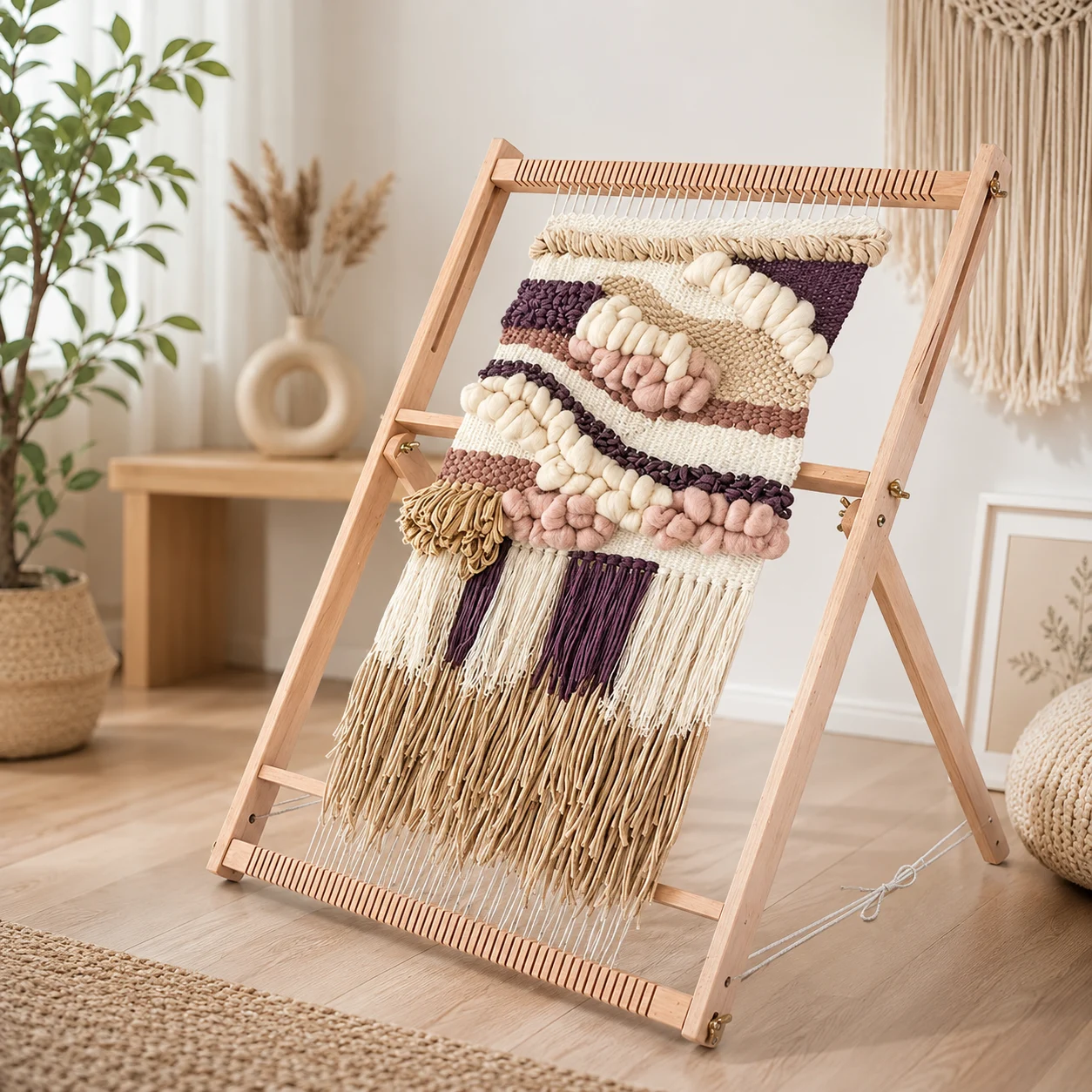
A tapestry loom and a plain frame loom are the same physical tool — wooden A-frame, notched bars, hand comb — the difference is entirely in technique. Once you understand weft-faced weaving, the same LoomCraft frame you use for a simple woven coaster becomes capable of genuine tapestry work.
What actually makes it "tapestry" weaving
In an ordinary weave, warp and weft show roughly equally — that's what gives fabric like a scarf its even texture. Tapestry flips that: the warp becomes invisible scaffolding, and every visual detail — color blocks, shapes, gradients — comes from how you pack the weft. That's why beating technique matters more in tapestry work than in almost any other hand-weaving style.
Beating: the technique that defines tapestry
New tapestry weavers often under-beat because it feels like more effort than the fabric seems to need. Push through that instinct. After every row, take the comb and pack the weft down with firm, even pressure, then check by eye whether any warp thread is still visible through the row you just wove. If it is, that row needs another pass with the comb before you move on. This single habit, more than yarn choice or loom size, determines whether a tapestry piece looks professional.
Blending colors on a tapestry loom
The simplest place to start is hatching: instead of finishing all of color A then starting color B in the next row, alternate a few picks of A and B along the boundary between them for two or three rows. It softens what would otherwise be a hard, blocky color change. Every LoomCraft kit ships with all 12 yarn colors included, which is exactly what makes color-blend practice possible without ordering more yarn mid-project.
Fringes: finishing your tapestry cleanly
Loose fringe suits a rustic wall hanging; braided or twisted groups suit a piece meant to hang somewhere more formal. Either way, tie off in pairs first — an untied warp end is the most common reason a finished tapestry starts unraveling from the bottom edge within the first few weeks on the wall.
Caring for your tapestry loom between projects
A frame loom has very little that can go wrong mechanically since there's no moving heddle mechanism to maintain — the wingnuts and dowel pegs are the only hardware. Re-tightening the wingnuts before you re-warp, and keeping the wood away from damp basements or direct radiator heat, is essentially the entire maintenance routine.
A technique with a long history
Weft-faced tapestry weaving isn't a modern craft trend — it's one of the oldest continuously used hand-weaving techniques. The same logic you're practicing on a small lap loom today, packing weft to hide the warp, shows up in tapestry-weave textile fragments from ancient Egypt that museums still hold in their collections.
How far back Coptic Egyptian tapestry-weave textile fragments in the Met's collection date, using the same weft-faced logic taught on a hand loom today
— Metropolitan Museum of Art collection records, 2024
Americans who knit or crochet, a reminder that hands-on fiber crafts, tapestry weaving included, are a mainstream hobby
— Craft Yarn Council, 2024
Knitting-forum posts analyzed in a study finding needlecraft hobbies support stress relief and a sense of identity, benefits that carry over to tapestry weaving
— University of Gothenburg, Journal of Occupational Science, 2024
Frequently asked
Do I need a special tapestry loom, or is a standard frame loom enough?
A standard frame loom works fine. Tapestry is a beating and color technique, not a different piece of hardware. The notched rod included with our Large kit can help with finer warp spacing on detailed tapestry work, but it isn't required to get started.
Why does my tapestry still show warp lines after I finish?
Almost always under-beating. Go back through with the comb and pack each row again with firmer, more even pressure, especially at the edges, before assuming the yarn or loom is the problem.
How many colors do I actually need to start blending?
Three to four colors is enough to practice hatching and simple gradients. Our 12-color yarn kits give more room to experiment without a separate yarn order.

Dana Whitfield · Weaving Editor, LoomCraft
Dana writes LoomCraft's weaving guides: warping, weaving and finishing on a frame loom, from a first coaster to a wall hanging.
Reviewed and updated July 5, 2026. See our frame loom guide for terminology.
Related reading: How to use a weaving loom · Weaving loom for beginners · Best weaving loom, compared · Reviews · All guides
The most tapestry-ready kit: extra shuttle, notched rod, and a full 12-color palette for blending.