
· Dana Whitfield
The Types of Weaving Looms, and How Old They Really Are
Search for types of weaving looms and you get shopping categories: frame, rigid heddle, table, floor. Useful if you are buying this afternoon, but it explains nothing about why those four exist, or why three of them are variations on one idea.
There is a better sort, and weavers and archaeologists both use it: ask what is doing the pulling. Warp threads must be held straight and tight before a row of weft can cross them, and there are only three ways to do it.
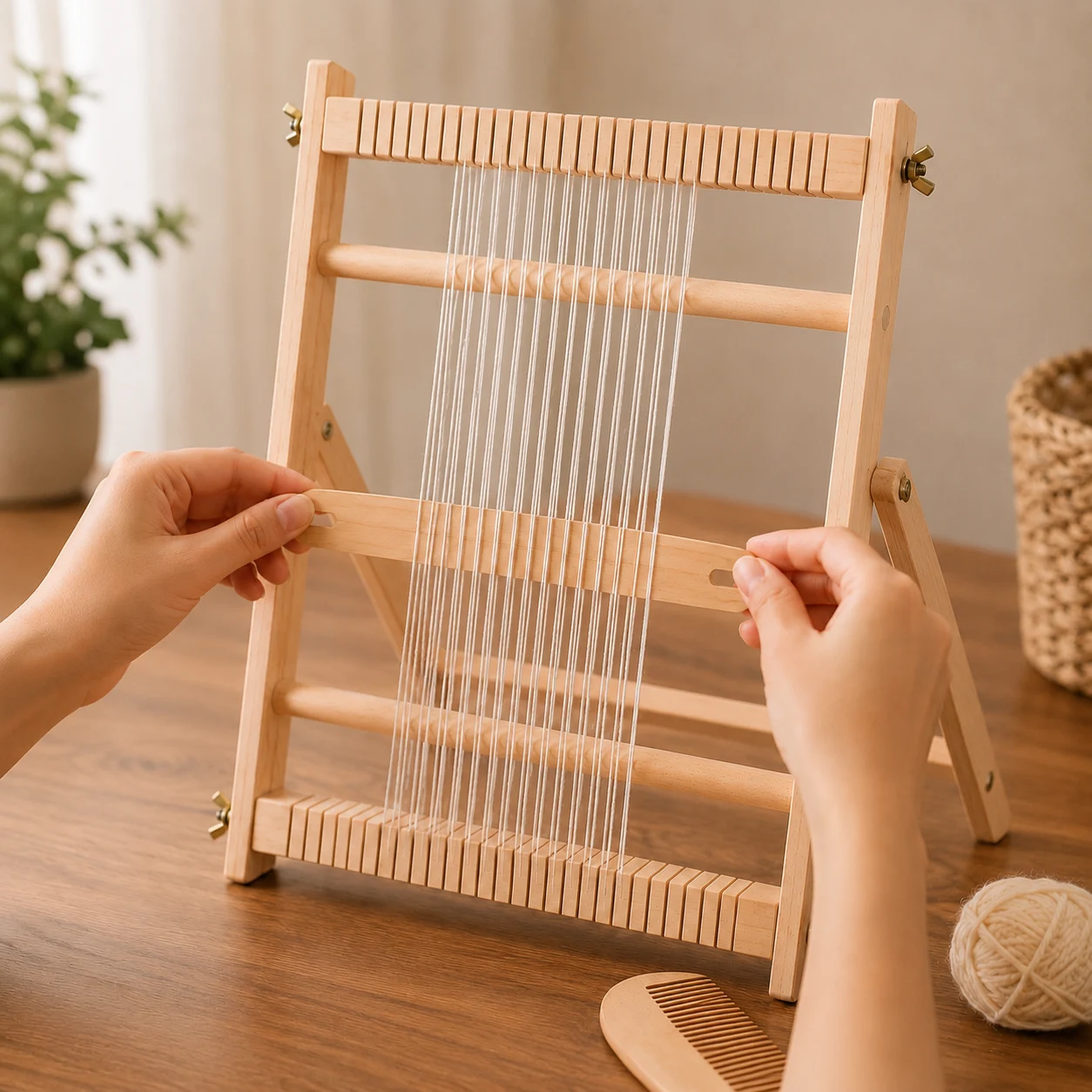
The one question that sorts every loom
A rigid frame holds it. Two beams held apart by a structure stiff enough not to bend, with the warp stretched between them. The tension is built into the woodwork and does not change while you weave. Frame, upright two-beam, table and floor looms are all this family.
Gravity holds it. One beam up high, the warp hanging straight down, weights tied to the loose ends doing the pulling. Nothing underneath is fixed to anything. This is the warp-weighted loom.
Your body holds it. One end of the warp tied to a post, the other to a strap around the weaver's hips. Lean back and the warp tightens; lean forward and it slackens. That is the backstrap loom, the only family where tension is a live decision made row by row.
The oldest loom anyone can actually point to
The dish came out of a grave at Badari and is held by the Petrie Museum at University College London as UC9547. Painted on the inside is a horizontal ground loom: two beams laid flat on the earth, held apart by four pegs. Published dates for it vary by several centuries.
Date given for the Badari dish (UC9547), the earliest surviving depiction of a loom
Two thousand years later the same loom was still standard, and this time we have it in three dimensions: a painted wooden model of a weaver's workshop, the loom pegged out on the floor and the weavers at work around it.
Date range of the Met's Fragmentary Model of a Weaver's Shop (30.7.3), a workshop in miniature built around a ground loom
— Metropolitan Museum of Art collection records, 2024
What is striking is how little the problem changed. Those weavers solved warp tension, even spacing and weft packing, in that order — the order you still work in, set out in our guide to using a weaving loom.
The warp-weighted loom, and the wall it leaned on
This is the loom of Bronze Age and Iron Age Europe, and the one archaeologists find most often, for a blunt reason: the weights were fired clay, and fired clay outlasts everything else in the room. A row of weights on an excavated floor is the shadow of a loom that stood there.
In 2026 a team publishing in Antiquity reported something rarer at Cabezo Redondo in southern Spain: not only weights but charred wood and plant-fiber ropes alongside them, which they read as a warp-weighted loom caught in the moment it was being used, capable of more than plain tabby and probably of early twill.
Age of the warp-weighted loom remains excavated at Cabezo Redondo, southern Spain — charred wood and fiber ropes found with the clay weights
It is the one family with no living descendant in a craft room. It needs a wall to lean on and floor space to stand in, and every advantage it had was absorbed by the upright two-beam loom, which asks for neither.
The backstrap loom: tension you hold with your own back
It sounds precarious and is the opposite: tension held by the body can be adjusted continuously, by fractions, mid-row. Backstrap weavers produce some of the most technically demanding cloth made anywhere.
What it trades away is scale and repeatability: your cloth is as wide as your arms reach, and setting it down mid-piece means finding the same tension again afterwards. That trade is the whole reason frames exist. A frame remembers the tension for you, which is why a piece can be left mid-row for a week and picked up unchanged, and why beginners are pointed at frames first in our beginner's guide.
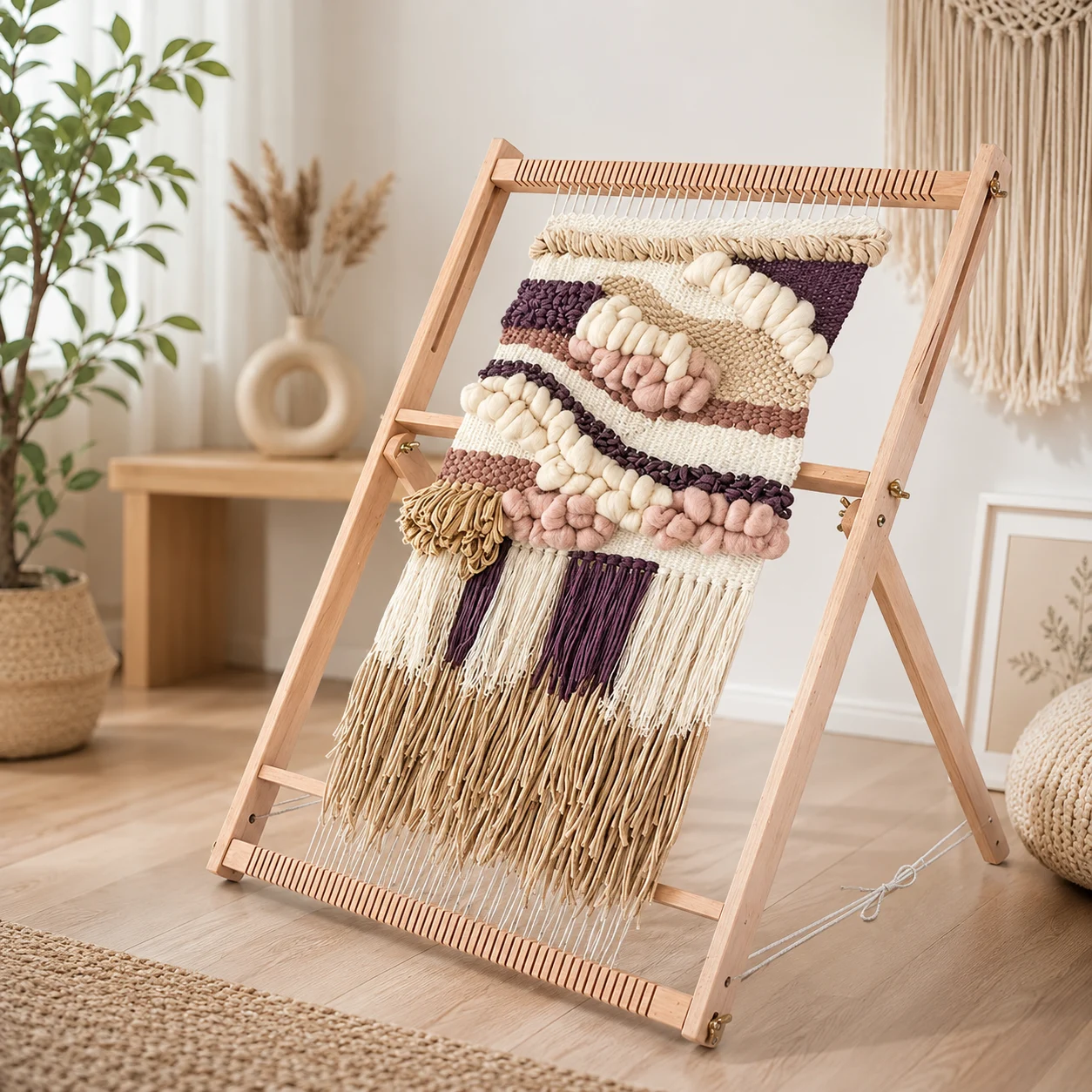
Native American looms: the upright loom of the Southwest
That detail matters more than it sounds. The Bard Graduate Center's Shaped by the Loom exhibition describes the Dine warp as one long continuous piece, typically seven to twelve warps per inch, carried on a frame of upright poles. A continuous warp means no loose ends at the top and bottom edges, which is why finished pieces can come off the loom with four selvedges instead of fringe.
Warps per inch typical of the Dine upright loom, wound as one long continuous cord on a frame of upright poles
Pueblo looms solved it differently: the same source records them as often suspended from the roof beams of a kiva, anchored below by heavy stones, with tension adjusted by the rope that tied the loom top and bottom. The Smithsonian's National Museum of the American Indian holds loom models and unfinished weavings, collected so the technique, not just the textile, would be preserved.
One point of terminology, regularly muddled online: an upright loom in this tradition is not a smaller floor loom. There are no treadles and no shafts. The weaver opens the path by hand and packs each row hard, which puts it in the same structural family as the weft-faced work in our tapestry weaving basics guide.
What people mean by an "old fashioned loom"
| The loom | What it actually was | What carries on today |
|---|---|---|
| Ground loom | Two beams pegged flat to the earth | Still woven in nomadic traditions |
| Warp-weighted loom | Beam leaned upright, clay weights pulling the warp down | No craft-room descendant |
| Backstrap loom | Warp tied between a post and a strap around the weaver | In daily use across the Americas and Asia |
| Upright two-beam loom | Warp held between a fixed top and bottom beam | Direct ancestor of the frame loom |
| Treadle floor loom | Shafts raised by foot pedals, warp on a roller beam | Still standard for long lengths of cloth |
Four of the five are still in use somewhere. Looms are not a technology that got replaced, but one that branched, and each branch kept the job it was good at.
What we can say from our own bench: Dana assembles and warps every LoomCraft size before it ships, and the setup notes are in how we test. We have not woven on a warp-weighted or backstrap loom, so the historical sections above are sourced to museum and excavation records, named and dated.
The three looms you will actually meet today
The frame loom does none of it, and that is its design rather than its limitation. You lift the warp threads yourself, which means you decide, thread by thread, where the weft goes — the freedom that makes weft-faced tapestry possible. The tool itself is set out in our frame loom guide.
The rigid heddle loom adds one moving part that lifts alternate threads together, trading some of that per-thread freedom for speed on plain repeating cloth. The full comparison against a frame lives in that same guide.
The floor loom scales the idea up with multiple shafts and foot treadles, storing metres of warp on a roller so you can weave cloth by the yard. It is a piece of furniture, which is both the point of it and the cost of it.
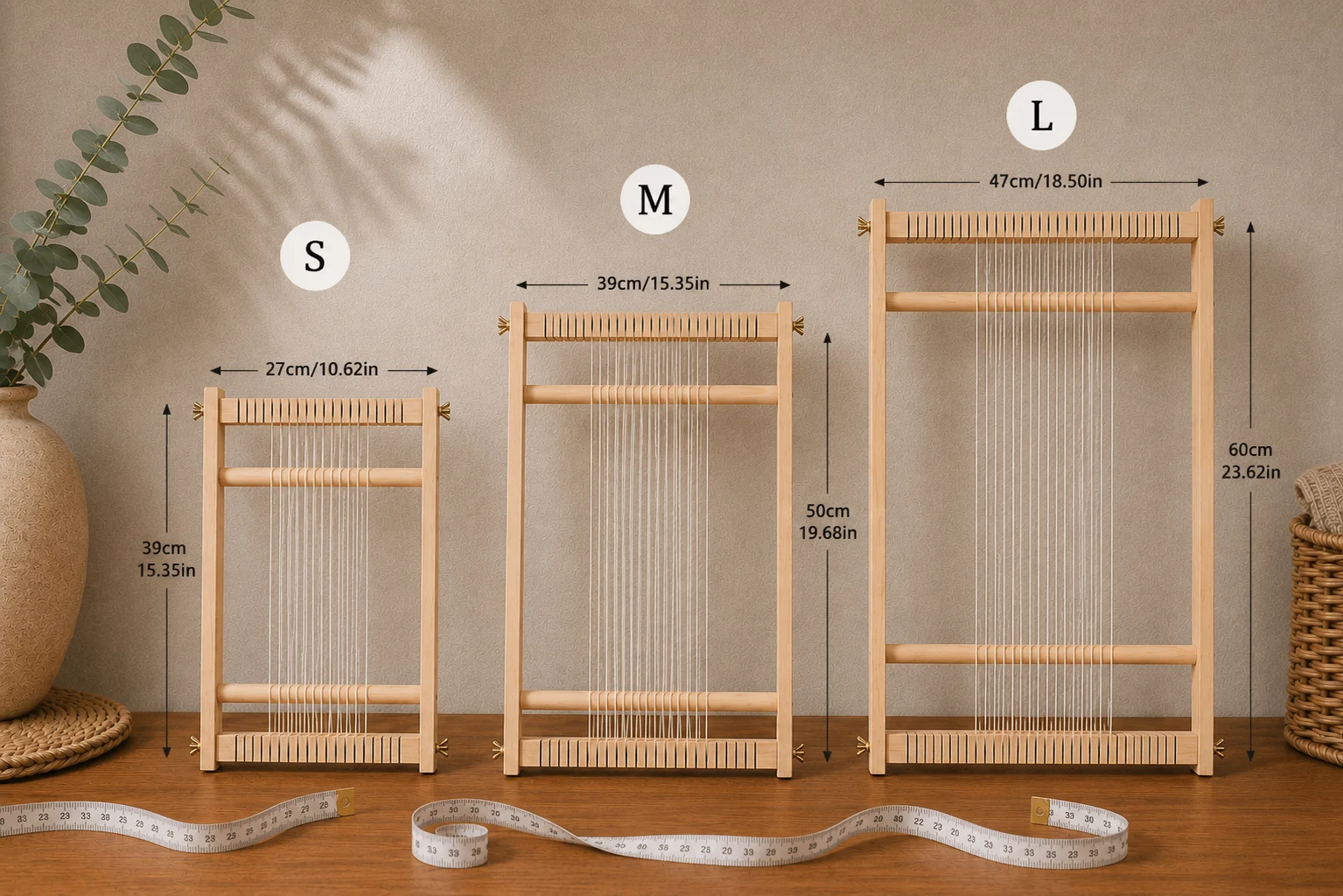
Our three sizes all sit in the first group: the Small at 39 × 27 cm, the Medium at 50 × 39 cm, the Large at 60 × 47 cm, each with the frame, comb, two forked shuttles and the 12-color yarn set, and a notched rod in the Large for finer warp spacing. The weaving loom kit page lists what is in each box.
Two bars, an even warp, and a comb: the same three ideas the weaver on that Badari dish was working with, at a size that fits on a table and comes off it as a finished piece once you have tied the warp off.
Frequently asked
What are the three main types of weaving looms?
It depends on whether you mean today or across history. Today: the frame loom, the rigid heddle loom, and the floor loom. Across history: the ground loom, the warp-weighted loom, and the backstrap loom. The second three are where the first three come from.
What is the oldest known weaving loom?
No complete ancient loom survives, because looms were wood and wood rots. The oldest picture of one is a painted dish from a grave at Badari in Egypt, held by the Petrie Museum at University College London and dated to around 3600 BC. It shows a ground loom pegged flat to the ground.
What kind of loom did Native American weavers use?
Two types are recorded in the Southwest: the backstrap loom and the upright loom. Dine weavers work on an upright loom, a standing wooden frame holding the warp beams, wound with one continuous warp cord. Pueblo looms were often suspended from kiva roof beams, anchored below with heavy stones.
Is a frame loom an old fashioned loom or a modern one?
Both, and that is the point of it. The two-beam upright loom it descends from is thousands of years old, and the geometry has not needed changing: hold the warp between two bars, keep it even, pack the weft. What is modern is the packaging. A LoomCraft kit arrives with the frame, comb, two forked shuttles and 12 yarn colors.

Dana Whitfield · Textile Craft Curator, LoomCraft
Dana test-weaves every LoomCraft size on real tapestry projects, timing setup, checking warp tension, and how the notched bars hold up.
Reviewed and updated August 20, 2026. See how we test, or the terminology in our frame loom guide.
Related reading: Tapestry weaving basics · How to use a weaving loom · Weaving loom for beginners · All guides
Frame, comb, two shuttles, notched rod and 12 yarn colors included. Arrives in 6 to 10 business days.